



A multi-country CX delivery model is a “single” customer support system operated from multiple countries. Each location performs specific tasks based on language, time zone, or market needs. Also, all the teams use the same processes, technology, and service standards. This allows a company to serve customers across different regions through one connected support network.
Want to know one of the biggest threats in CX operations? It is “concentration risk”. A customer support team may deliver excellent service every day. But if all operations depend on a single country, one unexpected disruption can affect the entire customer experience.
Natural disasters, internet outages, geopolitical events, labour shortages, or regulatory changes can all interrupt service delivery. In fact, between 2023 and 2025, 34% of companies with single-country CX operations experienced at least one material disruption that affected customer service for more than five business days.
By comparison, businesses with multi-country CX operations reported 4x lower disruption rates and recovered 3x sooner when disruptions occurred. So, want to set up a split delivery outsourcing model by distributing CX operations across countries? Read this article to learn what a multi-country CX delivery model is, how it works, its various components, and the advantages.
What is the Multi-Country CX Delivery Model?
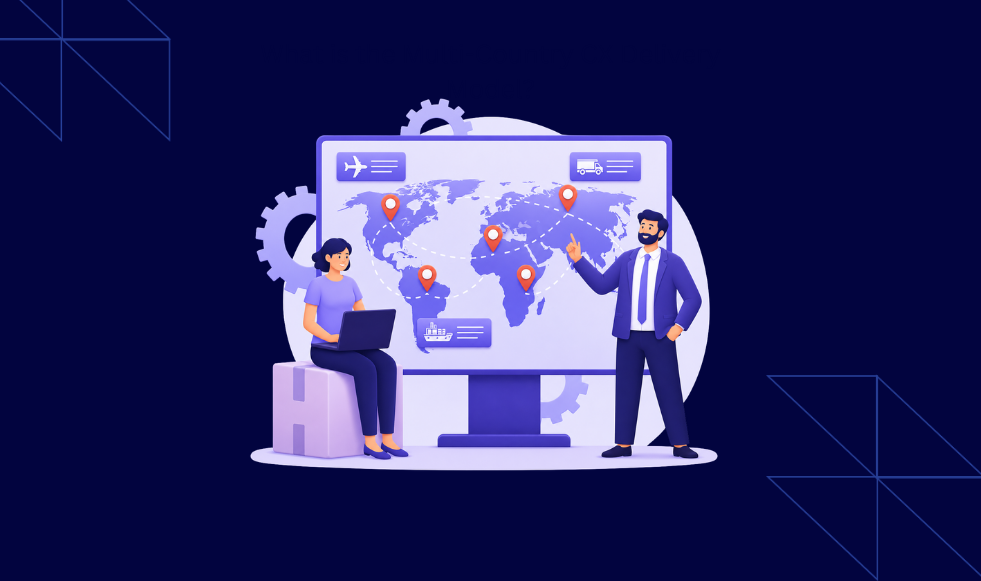
A multi-country CX delivery model (also known as “split delivery outsourcing model”) is a customer support system that operates from more than one country. For those unaware, CX includes every interaction a customer has with a company, such as phone support, live chat, email, social media, and self-service portals.
Now, instead of handling all customer service from a single office or country, a company sets up support teams in different countries. All these teams work together and follow the same company rules, processes, and technology.
The primary advantage? The customer experiences “one brand”, even though different teams may handle different interactions. Additionally, distributed CX operations across countries allow the business to serve customers in different regions without depending on a single location.
How Does the Split Delivery Outsourcing Model Work?
Firstly, the company creates a multi-location outsourcing strategy and develops a global framework for customer service. Generally, this framework includes:
- Service standards
- Customer service processes
- Quality rules
- Technology platforms
- Performance targets
Support teams in different countries then follow this same framework. For example:
- One country may handle English phone support.
- Another may manage local-language chat.
- A third country may answer customer queries during night hours.
Although different teams handle different tasks, they all use the same CRM system, knowledge base, and service guidelines. This gives customers a similar experience across every channel.
Additionally, studies show that the multi-country CX delivery model also delivers 18–22% average cost savings through geographic diversification, with organisations recovering their transition investment within 12 to 18 months.
That’s why several growing D2C companies operating across the US, UK, and Australia have started adopting the split delivery outsourcing model to improve CX.
What are the Primary Parts of the Multi-Country CX Delivery Model?
A successful multi-country CX delivery model includes the following four key elements:
| 1. Central Governance | 2. Regional or Local Teams | 3. Shared Technology | 4. Standard Training and Quality Checks |
|
|
|
|
Example
Suppose an online retail company serves customers in India, the Philippines, and Malaysia.
- The India team handles Hindi support.
- The Philippines team manages the English live chat.
- The Malaysia team covers customer requests after Indian business hours.
All three teams use the same CRM, customer records, and service guidelines. Now, if a customer contacts the company, they interact with one brand. They usually do not know which country’s team is providing support because every team follows the same service standards.
How Are Customer Support Operations Distributed Across Different Countries?
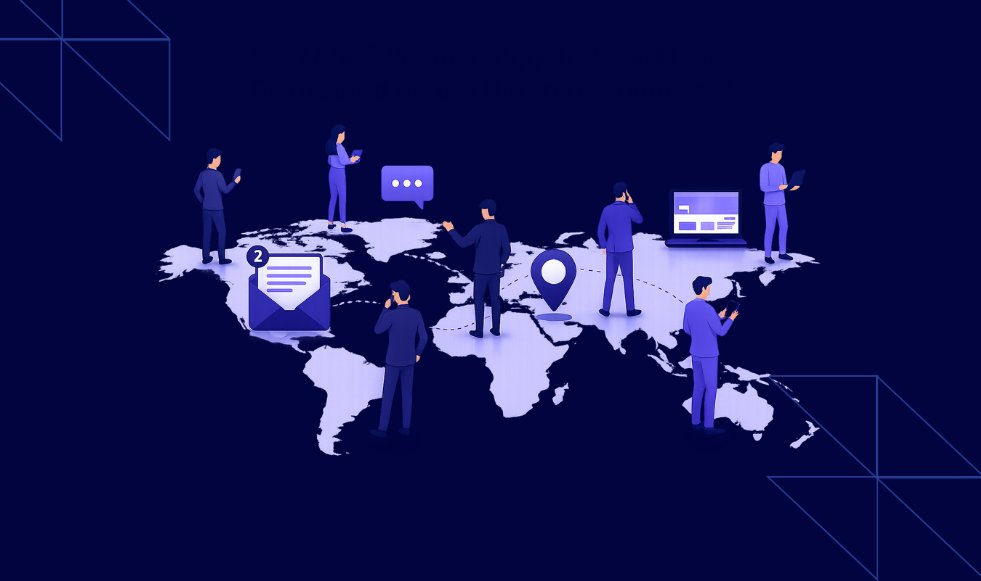
A multi-country CX delivery model works best when customer support is divided across multiple locations strategically. Instead of giving every site the same responsibility, companies assign different roles to each location based on its size, capabilities, and business importance.
This creates a “connected network” where every site has a specific purpose. If one location faces a disruption, another can continue handling customer interactions. A common approach for multi-geo CX staffing is the three-tier model, which includes a Primary Site, a Secondary Site, and a Contingency Site.
Let’s understand in detail:
| Site | Share of Customer Support Volume | Primary Role | Key Responsibilities |
| Primary Site | 50% to 70% | Main delivery centre |
|
| Secondary Site | 25% to 40% | Backup operational centre |
|
| Contingency Site | 5% to 15% | Emergency and overflow support |
|
A) Primary Site: The Main Customer Support Hub
The primary site is the largest and most important location in the multi-location outsourcing strategy. It usually handles 50% to 70% of all customer interactions, making it the central hub for daily operations.
Since this site manages the highest workload, it also has the largest workforce, experienced managers, and senior team leaders. Companies assign their most complex customer issues to this location because it develops deep operational knowledge over time.
New service processes, quality standards, and leadership development programmes are often introduced here before being implemented across other locations. As the main delivery centre, the primary site sets the operational standard for the rest of the network.
B) Secondary Site: The Operational Backup That Works Every Day
The secondary site usually manages 25% to 40% of customer interactions. Unlike a traditional backup office that remains idle until an emergency occurs, this site operates every day and handles live customer requests.
Its main purpose is to reduce dependence on the primary location. Since the team already manages real customer interactions and follows the same processes, it can take over a significant share of work if the primary site experiences a disruption.
Since the secondary site remains active throughout the year, its employees stay familiar with company systems, policies, and service standards.
C) Contingency Site: Capacity for Unexpected Situations
The contingency site is the smallest location in the split delivery outsourcing model and usually handles 5% to 15% of customer interactions. During normal operations, it manages overflow requests and specialised customer queues. This allows the team to remain active and familiar with the company’s systems instead of waiting for emergencies.
Its most important role begins when another delivery centre experiences a disruption or an unexpected increase in customer demand. In such situations, the contingency site expands its operations and supports the primary and secondary locations by handling additional customer interactions.
This “extra layer” of support strengthens business continuity and gives companies additional operational capacity whenever it is needed.
Why Growing D2C Companies Prefer a Multi-Country CX Delivery Model?
A multi-country CX delivery model offers much more than merely offering support from different locations. It helps businesses build a customer service network that is stronger and better prepared for changing business conditions.
Instead of depending on one country, companies distribute customer support across multiple locations. It has been commonly observed that a blended delivery center strategy usually:
- Reduces operational risk
- Expands access to skilled professionals
- Extends service availability, and
- Creates a balanced cost structure
As a result, businesses can maintain service quality while supporting customers across different regions. Want to understand in detail? Below are four major benefits of a multi-country CX delivery model:
1. Don’t Let One Disruption Stop Customer Support
One of the biggest advantages of a multi-country CX delivery model is risk diversification through outsourcing locations. When all customer support operations are based in one country, any major disruption can affect the entire customer service function. Such disruptions may include:
- Natural disasters
- Political instability
- Internet outages
- Power failures
- Public holidays, or
- Changes in government policies.
Multi-geo CX staffing reduces this risk by spreading operations across different locations. If one delivery centre faces an issue, customer interactions can be redirected to teams in another country. This helps the company continue serving customers with minimal disruption.
Additionally, this approach also supports business continuity planning, since operations do not depend on a single office or labour market. According to industry benchmarks, companies with diversified CX operations report 99.7% uptime, compared with 97.2% uptime for businesses that operate from only one location.
Thus, even a small improvement in uptime can prevent service interruptions and protect customer satisfaction.
2. Use Global Time Zones to Extend Customer Service Hours
A multi-country CX delivery model allows businesses to use teams located in different time zones. This is often called a follow-the-sun approach. Instead of asking one team to work overnight shifts, companies assign customer support to different countries as business hours change around the world.
For example,
- Suppose one country’s team may complete its workday while another country’s team begins its shift.
- Now, this creates extended or near round-the-clock customer support without depending entirely on night shifts.
Realise that agents who work during regular daytime hours often deliver better service because they work during standard business schedules rather than overnight. This can improve customer conversations and service quality.
Industry benchmarks show that businesses record an 8% to 12% improvement in First Contact Resolution (FCR) when customer service agents work daytime shifts. Moreover, higher FCR means more customer issues are resolved during the first interaction. This reduces repeat contacts and improves the overall customer experience.
3. Access Skilled Talent from Multiple Countries
Every country has its own labour market, education system, language capabilities, and professional expertise. If a D2C company or a consumer brand recruits from only one country, it is limited to the talent available in that market.
A multi-country CX delivery model removes this limitation by allowing businesses to hire employees across several countries. For example,
- Suppose one country may offer strong multilingual support
- Another may have specialists in technical customer service
- And others may provide a large pool of graduates for high-volume support operations.
Now, this gives companies greater flexibility when building customer support teams. Another advantage is that labour markets do not experience hiring challenges at the same time. If recruitment becomes difficult in one country because of high competition or talent shortages, companies can expand hiring in another location.
According to industry benchmarks, organisations recruiting across three or more countries fill open positions around 40% sooner than businesses hiring in only one country. This helps companies maintain workforce capacity as customer demand grows.
4. Optimise Customer Service Cost (Without Compromising Quality)
Many VPs or directors of growing consumer brands assume that businesses expand customer support to other countries only to reduce labour costs. In reality, “cost optimisation” is about creating the right balance between service quality and operating expenses rather than selecting the lowest-cost location.
Why? That’s because different customer interactions require different levels of expertise. Complex technical issues, high-value customers, or specialised support may be assigned to countries with experienced professionals, even if operating costs are higher. At the same time, routine enquiries, order tracking, or basic account support can be handled from locations with lower operating costs.
This “hybrid approach” allows businesses to reduce total delivery costs while maintaining service standards across all customer interactions. According to industry benchmarks, companies using a blended delivery center strategy achieve 18% to 22% lower overall operating costs than organisations that rely on a single nearshore location.
Can’t Achieve the Desired Levels of CX? Outsource Your Customer Support Department to Atidiv in 2026
So now you know about the Multi-Country CX Delivery Model, its working, and the various key components. If we were to revise, it is a customer service operating model where support is delivered from two or more countries. This approach allows businesses to:
- Expand language coverage
- Extend service hours
- Reduce operational risk, and
- Access skilled talent across multiple regions.
A split delivery outsourcing model generally includes three delivery sites. The “Primary Site” acts as the main customer support hub and handles most customer interactions. In contrast, the “Secondary Site” supports daily operations and serves as a backup. Whereas, lastly, the “Contingency Site” manages overflow requests. This site can increase capacity whenever demand rises or another location becomes unavailable.
If your growing D2C company is planning to build or optimise a global customer support operation, Atidiv can help. With 16+ years of experience and 70+ global clients, Atidiv delivers “end-to-end” digital CX solutions for modern businesses.
Our expert team offers AI Customer Support Outsourcing services and delivers omnichannel customer support across voice, chat, email, social media, and messaging channels. We follow a “human-in-the-loop” model and combine automation with human expertise. To learn more, book a free consultation today!
Multi-Country CX Delivery Model FAQs
1. What does “delivery model” mean?
A delivery model explains how customer service is organised and provided. It answers questions such as:
- Where are the support teams located?
- Which team handles phone calls, chats, or emails?
- Which country serves which customers?
- What technology and processes do all teams use?
A multi-country CX delivery model spreads these responsibilities across different countries instead of keeping everything in one place.
2. What is a “follow-the-sun” model?
Realise that different countries are in different time zones. While adopting a multi-country CX delivery model, several companies use the “follow-the-sun” technique to provide support throughout the day. In this technique, when one country’s workday ends, another country’s team starts its shift.
For example:
- Assume that India supports customers during its business hours.
- When India closes, the Philippines continues to support.
- Later, another country takes over.
In this way, customers can contact the company at almost any time without one team working overnight.
3. Why do companies use the multi-country CX delivery model?
Companies choose a multi-country CX delivery model for several reasons.
- It supports business expansion into new countries.
- It reduces dependence on one office. If one location faces a disruption, another team can continue customer support.
- Customers can receive support in their own language.
- Different time zones help extend service hours.
- During busy periods, work can be shared between countries instead of overloading one team.
This helps global companies maintain similar service standards while meeting local customer needs.

Ayushi leads Customer Experience services at Atidiv with a strategic/operations-focused mindset. Her primary objective is to increase how well businesses deliver service and retain customers. She evaluates customers' journeys through marketing impact, performance metrics, and gaps to develop improved systems and processes. With a reputation for curiosity and structured thought processes.