


The AI customer support platform you use should help grow your business, not limit its growth. From AI-powered chatbots to intelligent assistants, businesses are finding new tools to increase operational efficiency and enhance customer satisfaction.
Vendor lock-in remains one of the most underestimated risks in enterprise technology. As businesses invest more heavily in AI, vendor lock-in becomes complex. Today it can occur across LLM providers, AI workflows, orchestration tools, and the entire AI data pipeline.
This guide breaks down what AI vendor lock-in customer support is, why it matters, hidden costs to watch for, and practical multi-vendor AI strategy support without sacrificing flexibility.
Quick Takeaways
- Choosing the wrong AI platform can lead to expensive vendor lock-in and reduced flexibility.
- You’re locked into an AI vendor when your support data, workflows, and agent training are so baked into their platform that changing is either too expensive or risky to contemplate.
- Lock-in is not just about pricing. It can be seen in data portability, contract terms, and how embedded your team’s workflows are into one vendor’s system too.
- Data ownership, exit clauses, and multi-vendor strategies reduce long-term business risk.
- The most successful CX teams build an AI ecosystem, not dependencies.
What is AI Vendor Lock-in in Customer Support?
| Quick Definition
AI vendor lock-in occurs when an organization’s accumulated AI becomes trapped inside a single vendor’s infrastructure, making it difficult or costly to switch platforms. |
Vendor lock-in doesn’t happen overnight. It gradually occurs when businesses start adding more AI-powered workflows. In AI customer service, this risk has new dimensions that did not exist with traditional helpdesks.
Vendor lock-in is not just a technical risk. It is a structural risk built into your data, workflows, contracts, and team processes.
- Your ticket history, chatbot training data, and workflows often live inside the vendor’s single-vendor ecosystem.
- Moving automations, escalation workflows, and intent to a completely new platform requires months of planning, testing, and implementation.
- Businesses that rely on a single AI platform may have limited flexibility when vendors revise their pricing models.
In real-world scenarios, businesses realize the vendor lock-in only when they try to leave and realize their AI knowledge base, macros, and agent behaviors don’t transfer cleanly to a new platform.
Why is AI Vendor Lock-in Customer Support Becoming a Growing Business Risk?
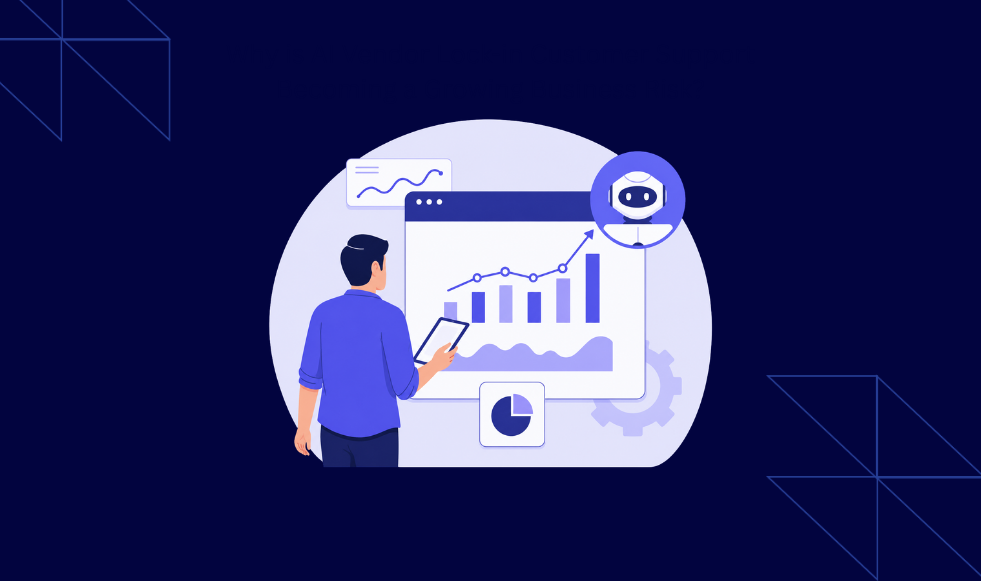
AI is one of the fastest-evolving enterprise technologies. A platform may seems convenient today. But it can become a long-term constraint in the future. The more you depend on one vendor, the more difficult it will become to remain agile, competitive, and in control. If you’re too tied to one AI vendor, it can quietly take away your flexibility over time.
Here are the potential risks.
- Vendor Lock-in Weakens Your Bargaining Position: When a vendor understands that you are deeply invested and unlikely to switch, they gain some advantage over you, and it is easier for them to raise prices.
- Workflow Lock-in: Vendor-specific logic is built into bots, macros, and escalation rules that don’t transfer to competitor tools.
- Data Lock-in: Long-term auto-renewals or no clear data-return clause make exiting legally and financially painful.
- Behavioral Lock-in: Agents and admins are specialists on one platform. There is a real productivity cost to retraining on a new tool.
From our experience, managing outsourced support across multiple AI platforms, workflow lock-in is one of the risks that most businesses underestimate. Exporting customer data is possible, but rebuilding years of optimized automation workflows, intent models, and escalation rules on a completely new platform can take time.
How Does AI Vendor Lock-in Affect the Customer Support Team?
Vendor lock-in not only hits the budget, but also can affect how the customer support team actually works day to day.
-
Limited Flexibility to Respond to Customer Needs
When your bots and workflows are hardwired to one single vendor often means waiting on the vendor’s roadmap instead of just switching tools.
-
Agents Spend Most of the Time Relearning the System Instead of Helping Customers
If leadership is going to switch eventually because pricing or performance gets bad enough, agents lose months of tuned muscle memory (macros, shortcuts, escalation habits) and have to rebuild that on a new platform from scratch.
-
Migration to a New AI Platform Can Temporarily Affect the Support Quality
Firms that have bought into a single solution have no backup plan for their efforts. If their particular piece of technology fails, experiences a poor model release, or gets purchased out, they have nowhere else to send traffic.
-
Less Bargaining Power With Vendors
The team that can walk away receives better assistance, pricing, and roadmap consideration from the vendor. The team that is trapped has to make do with whatever service level the vendor decides on, because the vendor knows that the team cannot move on.
-
Technical Debts Grow Over Time
Everything that is automatically added to a proprietary solution becomes something that will have to be redone. This is something that teams rarely appreciate until they attempt to leave and discover that the logic created during two years cannot be transferred elsewhere.
How to Avoid Vendor Lock-in AI Platforms?
It is really important to understand that vendor lock-in in AI platforms is inevitable. But these strategies can help you avoid vendor lock-in in AI platforms.
-
Identify Vendor Dependencies
Vendor lock-in may also be subtle and begin with small dependencies over time. Leadership in business and technology can take proactive steps to avoid disruptions by conducting periodic dependency reviews of which parts of their AI systems depend on external vendors. This will allow for discussions about building versus buying in the future.
-
Create a Vendor Exit Strategy
Do not wait for provider disruptions or rising business costs to think about the exit strategy. While designing your AI system, always look for alternatives for every critical dependency and include a migration plan right from the beginning. Take a regular check on the alternate provider to ensure that your business can switch with minimal disruption if your current vendor does not meet your expectations.
-
Implement Abstraction Layers
Avoid direct connection between the AI application and third-party components like ML models. Open APIs make it easier to connect with the different customer support systems and replace components later.
-
Adopt Open Standards
The risk of lock-in may be highest in proprietary infrastructures and platforms, so you might want to think about using open-source solutions and approaches for the development of your AI components. Some popular open-source items include Open Neural Network Exchange, Model Context Protocol (MCP), OpenLLM, and Hugging Face Transformers. In addition, you could use standard formats for data meant to enable data portability, like Apache Parquet, and open-source observability tools, like OpenTelemetry. These open-source items are created by the community and can be easily customized.
-
Adopt a Multi-Cloud Strategy
Cloud vendors are key providers of AI infrastructure and services. A multi-cloud strategy is designed with two primary objectives. First, it provides backups or alternate cloud services in case of downtime or disruption by switching between providers. Second, it allows the use of best-of-breed infrastructure and AI resources by using multiple providers at the same time.
Why is Avoiding Vendor Lock-in AI platforms Important Right Now?
The landscape of AI is changing at a remarkable speed. Every day we are witnessing the release of new large language models, customer support tools, and automation capabilities; these releases give businesses more options than ever before. If your customer support is tied to a single vendor, adapting to these new changes can be exhausting, and AI platform switching costs are equally expensive.
Avoiding AI vendor lock-in allows your business to be more agile and competitive. Here is why avoiding vendor lock-in with AI platforms is very important for your business.
- AI technology is evolving rapidly: With a flexible setup, you can easily move your operations to a new platform without rebuilding your entire ecosystem.
- Pricing models may evolve: Most of the AI vendors regularly update their pricing, and being locked in with a single vendor will limit your ability to negotiate.
- Your AI strategy should evolve with your business: As your business grows, you may need AI solutions with more advanced capabilities, deeper integrations, or industry-specific features that your current provider can provide.
- Compliance and regulatory standards continue to evolve: Changing compliance standards may require your business to move to a more stable provider providing better security, governance features, and data privacy.
What Does the Research Say About the Vendor Lock-in?
|
In particular, for customer service, the issue is even more pressing since customer service operates around the clock. An outage by the vendor, increased prices, or changes in features don’t just lead to internal disagreement but affect the customer right away.
Why is a Multi-Vendor AI Strategy Important for Customer Support?
Relying on a single AI vendor may seem convenient during the early stages of implementation, but it can limit your ability to innovate and adapt. There is no single platform that excels in all aspects of customer support. One may be the best in providing conversational AI, while another provides superior analytics, work automation, and multilingual capabilities.
A multi-vendor AI strategy is the approach of using multiple vendors for services instead of relying on a single vendor. Businesses may use this technique to minimize risks, improve availability, and negotiate competitive prices.
Here is why a multi-vendor AI strategy is important.
- Negotiating Power: Vendors compete for your business when you are not locked into a single contract.
- Resilience: If one of your AI support agents has an outage or support strike, your support need not stop operations.
- Best fit tooling: Different models and platforms are stronger at different times.
- Compliance Flexibility: Flexible multi-vendor support makes it easier to adapt to the changing data residency and compliance requirements.
Here are the key features of the single-vendor and multi-vendor AI support
| Single Vendor | Multi-Vendor |
| Simpler implementation | Greater flexibility |
| Faster AI rollout | Reduced organizational risks |
| Simplified AI management | Great leverage with AI vendors |
| Greater AI dependency | Greater flexibility to upgrade technology |
| If juggling multiple AI support tools sounds like more work than it’s worth, Atidiv’s on-demand customer support outsourcing is designed to work flexibly across whatever stack you pick. |
How to Build a Flexible AI Tech Stack for Customer Service?
Building a flexible AI tech stack for customer service begins from day one. Don’t wait until you are stuck with one vendor to think about the exit.
-
Identify Your Existing Dependencies
List every AI tool touching support and what data/workflow lives inside it.
-
Prioritize API First, Standard-Based Tools
Favor vendors that support open standards, such as MCP (Model Context Protocol) for agent and tool interoperability.
-
Add an AI Orchestration Layer
Route AI requests through middleware, instead of hardcoding one vendor into every workflow.
-
Maintain Human Oversight
The trained human agents can absorb disruption if an AI tool goes down or underperforms.
-
Review Contracts Annually
Do not wait for the auto-renewals to lock in outdated terms as the support volume and needs grow.
In real-world scenarios, the businesses that handle the vendor changes smoothly are the ones that treated the AI as one interchangeable layer in a broader support strategy, not the strategy itself.
How Does a Flexible AI Tech Stack for Customer Support Look Like
A flexible customer support architecture often looks like this:
CRM
↓
Help Desk Platform
↓
Knowledge Base
↓
AI Layer
↓
Automation Tools
↓
Reporting & Analytics
What Should You Look for in Exit Clauses in AI Software Contracts?
A well-defined exit clause ensures you can recover your data, establishes a clear transition timeline, and limits the cost of switching providers.
At a minimum, ensure that your contract includes:
- Guaranteed Data Portability: Ensure tickets, transcripts, and training data are in a portable format you can use with another provider.
- Specified Transition Timeline: Set the number of days during which both systems can run in parallel.
- Reasonable Termination Fees: Limit or waive early termination penalties associated with standard contract expiration.
- Service Continuity Provision: What vendor obligations are if they acquire, shut down, or discontinue the product.
- SLA Linked Termination Rights: Ability to exit early if the vendor misses agreed service levels.
Common Mistakes That Increase AI Platform Switching Costs
You must have seen many businesses unintentionally create vendor lock-in problems due to poor planning.
❌Choosing software based only on AI features.
❌Neglecting data portability
❌Building workflows that are difficult to migrate.
❌Overlooking contract reviews.
❌Poorly documented integrations.
❌Assuming today’s AI vendor will remain the best forever.
How a Platform-Agnostic Support Partner Improves Customer Support Resilience?
Using a multi-cloud approach carries the possibility of increased adaptability for AI solutions if the platform supporting customer service makes use of cloud-based solutions. However, the use of several providers does not necessarily mean freedom from the constraints of dependency on specific platforms for AI solutions. The main concern is whether data, workflows, models, and service programs can be shifted from one environment to another depending on the situation.
At Atidiv, we help customers build flexible customer support solutions that perfectly combine AI automation with a skilled human team across multiple platforms. Whether you are expanding AI capabilities, migrating support systems, or scaling seasonal operations, our approach is designed to support your business operations.
Final Thoughts
AI customer support will continue to evolve rapidly. AI vendor lock-in customer support becomes a serious risk when your workflow integrations and support operations are tied to a single vendor. The best way to reduce the vendor lock-in is to build flexibility into your AI strategy. AI tool portability in customer service is making sure no single tool controls your entire customer experience operation.
Atidiv helps businesses build scalable business operations that perfectly combine AI automation and human expertise.
Frequently Asked Questions
-
What is vendor lock-in in AI customer support?
Vendor lock-in refers to structural limitations that make it too hard or costly to switch AI customer support vendors. In the age of AI, this problem is more than simply what is known as data portability; it includes questions of ownership of training data for the AI engines, portability of workflow configuration, reliance on models, and the collective knowledge of the organization in charge of the services.
-
Is a multi-vendor AI strategy worth the extra complexity in 2026?
Yes, for most of the customer support teams, a multi-vendor AI strategy is worth investing in. The primary goal is not using as many vendors as possible.
-
Why is AI tool portability important?
AI tool portability helps businesses adapt to new technologies, reduce migration costs, and avoid long-term dependence on a single vendor.

Ayushi leads Customer Experience services at Atidiv with a strategic/operations-focused mindset. Her primary objective is to increase how well businesses deliver service and retain customers. She evaluates customers' journeys through marketing impact, performance metrics, and gaps to develop improved systems and processes. With a reputation for curiosity and structured thought processes.